
On this page
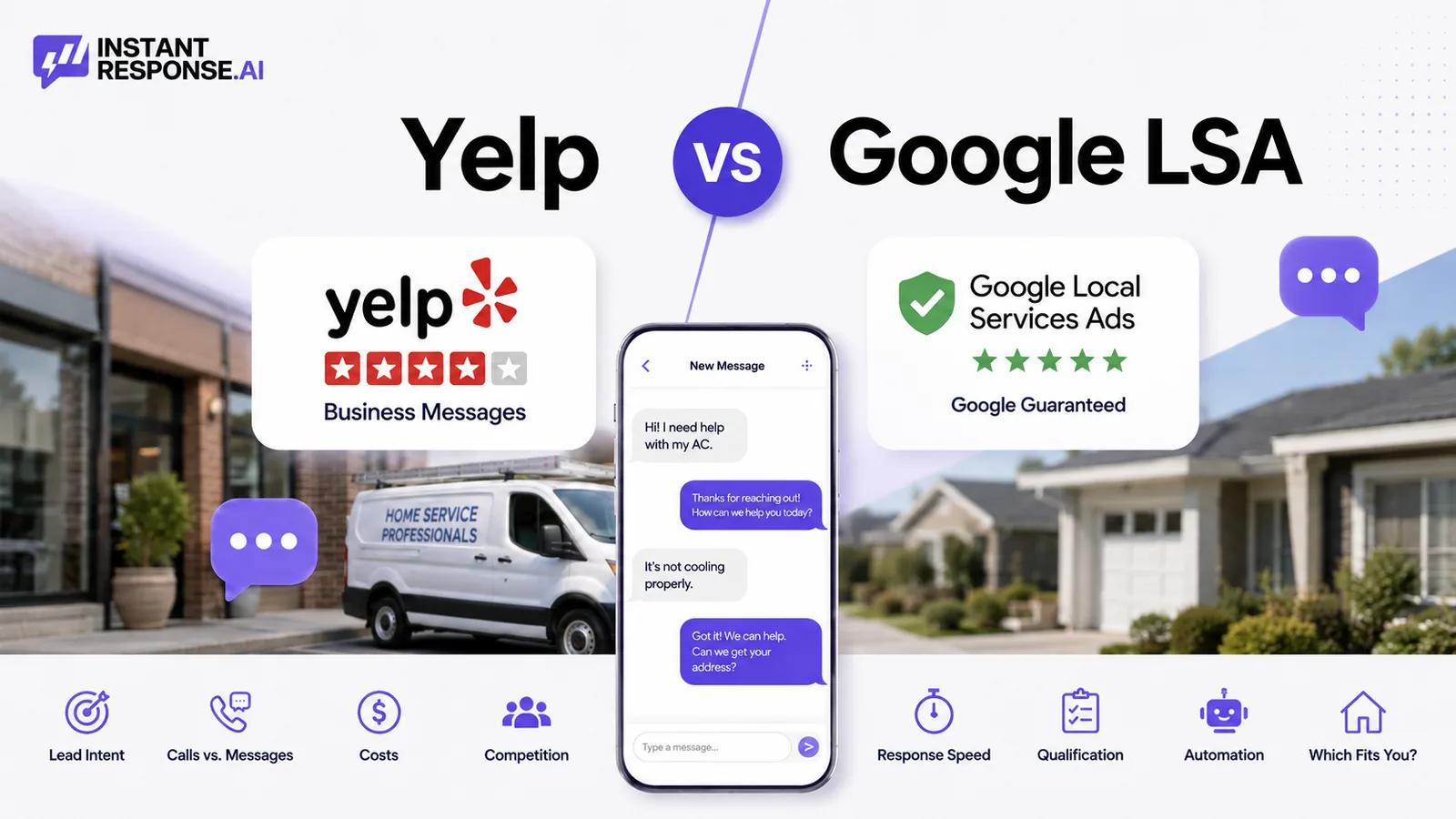
For a local service business, Yelp and Google Local Services Ads can both put you in front of customers who are actively looking for help. But they do not generate leads in exactly the same way.
A homeowner searching Google for an emergency plumber may interact with a Local Services Ad and call immediately. Another customer may browse Yelp, compare profiles, read reviews and submit a Request a Quote to one or several businesses.
Both customers may have strong intent. The difference is how they discovered you, how they prefer to communicate and how quickly your team needs to respond.
So if you are deciding where to put your lead-generation budget, the right question is not simply "Is Yelp better than Google LSA?" A more useful question is: which channel produces the right leads for my business, and can my team respond to those leads effectively?
This guide compares Yelp and Google Local Services Ads from the perspective of a local home service company.
What is Google Local Services Ads?
Google Local Services Ads, commonly called Google LSA, is Google's local lead-generation advertising product for supported service categories and markets. Local Services Ads can appear prominently when someone searches Google for a local service.
Depending on the business category, market and account setup, potential customers may be able to contact the business through:
- phone calls
- message requests
- supported booking experiences
Unlike a traditional pay-per-click search campaign, Local Services Ads is structured around paying for eligible leads generated through the platform rather than simply paying whenever someone clicks an advertisement. For local service businesses, this can put the business directly in front of customers searching for a specific service in a specific area.
What is Yelp for home service leads?
Yelp is a local discovery platform where consumers can research businesses, read reviews, compare options and contact service providers. For supported categories, Yelp's Request a Quote and messaging experiences allow customers to send businesses information about the work they need.
Depending on the flow, Yelp may ask the customer additional project questions before sending the inquiry. Customers may also have the option to send the request to additional businesses.
That detail matters. A Yelp lead can be highly motivated, but the business may still be competing with other providers receiving the same or similar request. That makes the quality and speed of the first response operationally important, which is why many companies eventually automate Yelp lead responses instead of relying on someone watching the inbox.
Yelp vs Google LSA at a glance
| Factor | Yelp | Google Local Services Ads |
|---|---|---|
| Primary discovery environment | Yelp local discovery and business profiles | Google Search |
| Common lead interaction | Messaging / Request a Quote | Calls and messages |
| Customer research behavior | Often includes profiles, photos and reviews | Often begins with a service search on Google |
| Can customers compare providers? | Yes | Yes |
| Can one project reach multiple businesses? | Possible in Yelp quote-request flows | Customer generally selects a provider profile when contacting through LSA |
| Phone leads | Possible through business presence, but Request a Quote is message-focused | Core LSA lead type |
| Message leads | Yes | Yes |
| Advertising billing model | Depends on the Yelp product or campaign | LSA charges for eligible leads under Google's current model |
| Reviews and reputation | Major part of Yelp discovery | Reputation and verification signals appear in the LSA experience |
| Automation opportunity | Fast responses to Yelp Requests | Fast responses to LSA message leads |
| Best fit | Depends on category, geography and customer behavior | Depends on LSA eligibility, category, geography and search demand |
This is why there is no universal winner. A channel can perform extremely well for one plumber or HVAC company and poorly for another business in a different market. The correct comparison is based on your actual qualified leads, jobs and acquisition costs.
Difference #1: where the customer starts
Google LSA begins with Google Search. The customer is usually searching for a service:
- "AC repair near me"
- "emergency plumber"
- "garage door repair"
- "locksmith near me"
The customer's problem already exists, and Google is helping them find a local provider.
Yelp has a different discovery environment. Customers may find a business through:
- Yelp search
- category pages
- business profiles
- reviews
- Yelp advertising
- Request a Quote
That can produce a slightly different customer journey. The important point is not whether one journey has "more intent." Both can represent serious buyers. What matters is whether your particular business receives the type of jobs it wants from each channel.
Difference #2: calls vs messages
One important distinction for operations is how the lead arrives.
Google Local Services Ads can generate phone calls as well as message leads. For businesses such as locksmiths, plumbers, HVAC companies and garage-door companies, urgent customers may prefer calling immediately.
Yelp Request a Quote is heavily oriented around asynchronous messaging and project information. That makes response workflows important on both channels, but in different ways.
A business using Google LSA needs a strategy for:
- answering calls
- following up on missed calls
- responding to message leads
A business using Yelp needs a strategy for:
- replying to new Requests
- asking qualifying questions
- quoting according to approved rules
- following up when customers stop responding
Difference #3: competition after the lead arrives
Getting the lead is only the first step.
On Yelp, a customer submitting a quote request may be able to send the project to additional businesses. That means several providers can be competing for the conversation. The business that gives the customer a useful response while the project is still active has an operational advantage over a business that sees the message several hours later.
Google LSA works differently. A customer contacting you through your Local Services Ad has selected your business profile to make that contact. But that does not mean the customer cannot continue searching or contact another provider.
In either case, buying the lead does not guarantee the job. The team still needs to respond, qualify and move the conversation forward.
Difference #4: how you pay
The billing models should not be oversimplified.
Google Local Services Ads operates under a lead-based model for eligible Local Services leads. Yelp offers multiple advertising and business products, and the commercial structure can depend on the product being used.
For that reason, businesses should not compare the platforms using only "what does one lead cost?" A better calculation is marketing spend divided by qualified leads, and then marketing spend divided by completed jobs.
A $30 lead that never matches your service area is expensive. A $100 lead that becomes a profitable $2,000 job may be inexpensive. The source matters less than the economics.
Difference #5: response behavior
Response speed matters operationally on both channels.
Google explicitly encourages Local Services advertisers to respond to leads and currently notes that consistently failing to answer calls or messages may affect ad ranking. That is a good reason to have a reliable response process, but businesses should not interpret it as a guarantee that faster replies automatically produce higher rankings.
Yelp also creates a strong practical reason to respond promptly. If customers are comparing several businesses or sending quote requests to multiple providers, an unanswered message gives competitors more time to start the conversation.
The goal is not merely to answer fast. It is to answer fast with something useful.
Which is better for emergency home services?
For urgent service categories such as:
- locksmith
- plumbing
- HVAC breakdowns
- garage door problems
- water damage restoration
Google LSA can be especially attractive because customers are often searching Google at the moment the problem happens, and phone calls are a core lead type.
But Yelp should not automatically be excluded. Many consumers still use Yelp to find and compare local service providers. A business should compare its own results rather than assume that one platform always wins.
Which is better for planned home services?
For less urgent projects such as:
- carpet cleaning
- remodeling
- larger roofing projects
- scheduled maintenance
- cleaning services
- certain installations
customers may spend more time researching and comparing companies. Yelp's profiles, reviews, photos and quote-request workflow can fit that research process well.
Google LSA may also perform strongly where the service category is eligible and there is meaningful Google search demand. Again, the answer should come from business data rather than a generic platform ranking.
Should you use Yelp and Google LSA at the same time?
For many established local service businesses, yes. If both channels generate profitable work, there is no strategic requirement to choose only one. Running both can diversify lead acquisition.
Google LSA can capture people searching Google for a service right now. Yelp can capture people researching and requesting quotes within Yelp.
The operational challenge is that leads then arrive in multiple places. Someone has to monitor:
- Yelp
- Google LSA
- phone calls
- message leads
- follow-ups
This is where response systems become important.
The real problem is often not lead generation
A business can spend thousands of dollars generating leads and still lose opportunities because nobody responds at the right time. Consider what happens when:
- an LSA message arrives after office hours
- a Yelp Request arrives while the dispatcher is on another call
- a lead asks a follow-up question on Saturday
- three new inquiries arrive at the same time
- someone forgets to follow up with a quiet lead
At that point, the marketing channel may not be the problem. The response process is. Before increasing Yelp or LSA spend, businesses should make sure they have a reliable system for handling the leads they already buy.
How automation fits into Yelp and Google LSA
Automation should not replace every human conversation. It should reduce the time between a customer asking for help and receiving a useful next step.
For supported Yelp Requests, an AI response system can help:
- send the first response
- ask qualifying questions
- use configured service information
- use approved pricing information
- follow up
- escalate conversations to a person
The Yelp Auto Responder page explains how those rules are configured.
For supported Google LSA message leads, automation can similarly:
- reply quickly
- ask job-specific questions
- qualify the opportunity
- use configured rate-card information
- follow up
- route qualified leads to the team
The Google LSA Auto Responder page covers how to automate Google LSA message leads.
Google LSA phone calls are different. InstantResponse does not automatically answer LSA phone calls today. For LSA call activity available in the connected account, teams can instead review information such as recordings, transcripts, AI summaries, call duration and related lead context. This distinction is worth keeping clear when comparing tools.
How to decide where to spend more
Do not choose based only on the number of leads. Measure the funnel.
- Total spend
- Total leads
- Qualified leads
- Conversations reached
- Confirmed appointments or job opportunities
- Completed jobs where measurable
- Revenue where reliable attribution exists
Then calculate useful business metrics such as:
- cost per lead
- cost per qualified lead
- cost per booked opportunity
- cost per completed job
- revenue per lead where attribution is reliable
Do this separately for Yelp and Google LSA. After enough data, the answer becomes clearer.
A practical example
This is a hypothetical illustration, not a customer case study. A hypothetical HVAC company spends money on both channels. Google LSA generates fewer total leads but more emergency AC calls. Yelp generates more message-based requests for maintenance, replacement estimates and scheduled work.
It would be a mistake to judge either source only by lead volume. Instead, the company should evaluate:
- which jobs fit its target services
- which leads become real conversations
- which source produces profitable work
- whether the team can actually respond effectively
The result may be: keep both, increase one, reduce one, or change the response process before changing marketing spend.
Yelp vs Google LSA: which should you choose?
More Google LSA focus if
- your category is eligible
- customers frequently search Google for urgent service
- phone calls are valuable to the business
- LSA produces acceptable qualified-lead economics
- your team can reliably handle calls and messages
More Yelp focus if
- Yelp has meaningful consumer activity in your market
- your customers frequently compare providers
- reviews and project profiles influence the decision
- Request a Quote generates profitable inquiries
- your team converts message conversations well
Use both if
- both produce profitable qualified leads
- you want channel diversification
- your team or automation can manage both reliably
These are starting points for a decision, not universal rules. Your own numbers should settle the question.
Why response infrastructure matters more as you add channels
Every additional lead source creates another inbox or workflow that someone needs to monitor. InstantResponse is designed to help local service businesses manage supported message leads across Yelp, Google Local Services Ads and Thumbtack. It can use configured information such as:
- services
- service area
- business hours
- qualification questions
- approved pricing or rate-card information
- escalation rules
- follow-up rules
This allows businesses to use multiple lead channels without relying entirely on someone manually watching every inbox. The AI Auto Responder overview explains how that works across channels.
Frequently asked questions
Is Yelp better than Google Local Services Ads?
Not universally. Performance depends on the service category, location, competition, customer behavior, pricing and how effectively the business handles the leads. Compare qualified leads and jobs rather than assuming one platform is always better.
Does Google LSA generate phone calls?
Yes. Google Local Services Ads can generate phone call and message leads. Available lead types and features can vary by category and account.
Does Yelp send leads to multiple businesses?
In Yelp Request a Quote experiences, customers may have the option to send their project request to additional businesses. This means multiple businesses can sometimes compete for the same project.
Does responding faster improve Google LSA ranking?
Google currently recommends responding to Local Services Ads leads and states that regularly failing to answer calls or messages may affect ad ranking. Businesses should not interpret this as a guarantee that faster response alone will improve ranking.
Can you automate Yelp leads?
Supported Yelp Requests can be handled with an automation system that responds using the business's configured services, pricing information, service area and rules. See how Yelp Requests are answered automatically.
Can you automate Google LSA leads?
Supported Google LSA message leads can be responded to automatically. Phone calls are a separate workflow and are not automatically answered by InstantResponse today. See how LSA message leads are handled.
Should home service businesses advertise on both?
If both channels produce profitable, qualified opportunities, using both can diversify lead acquisition. The decision should be based on actual business results rather than platform preference.
Conclusion
Yelp and Google Local Services Ads are not interchangeable lead sources. Google LSA captures customers searching Google for local services and can generate both phone and message leads. Yelp combines local discovery, reviews, business profiles and quote-request messaging.
For some businesses, one will clearly outperform the other. For others, the best strategy will be using both. The most important thing is to measure beyond lead volume: track which source produces qualified opportunities, which leads become jobs and how quickly those customers receive a useful response.
Because generating the lead is only half of the process. The other half is what happens after the customer contacts you.